The 2026 tax year brings the first full round of changes under the One, Big, Beautiful Bill Act (OBBBA), which made the 2017 tax cuts permanent and added several new deductions for tips, overtime, seniors, and auto loan interest. Add in the IRS’s annual inflation adjustments, and taxpayers have a lot to track before these 2026 IRS tax law updates apply to returns filed in 2027. Effective tax preparation means understanding these new tax laws for 2026 well before filing season, not scrambling in the spring.
This guide from our team at Lewis.cpa breaks down what has changed in 2026 and helps you understand the new IRS rules.
Individual Income Tax Rates and Brackets for 2026
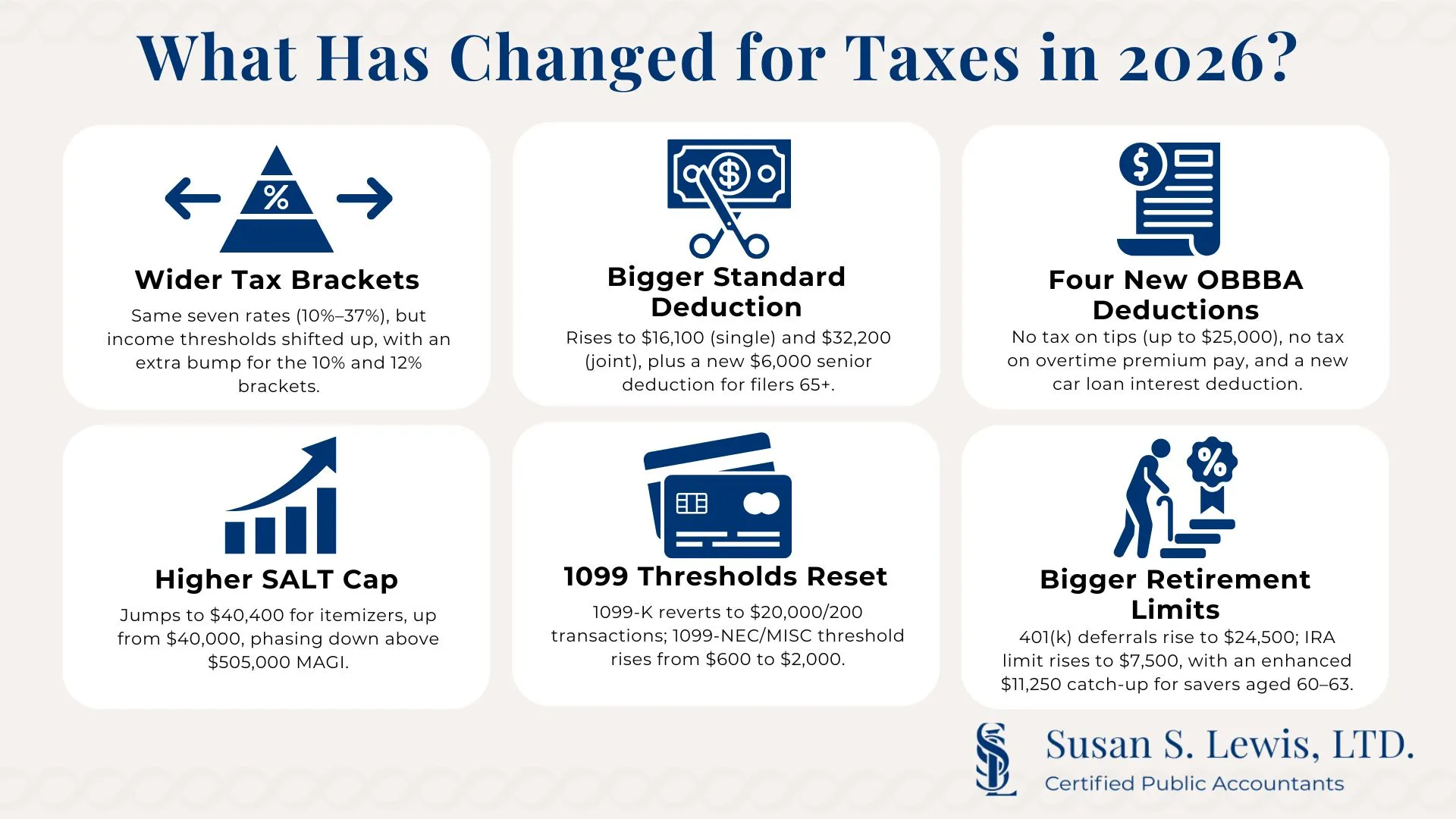
Every year, the Internal Revenue Service (IRS) adjusts individual income tax rates to account for inflation, and 2026 is no exception. The seven federal tax rates, 10%, 12%, 22%, 24%, 32%, 35%, and 37%, remain unchanged. The primary change is where each tax bracket begins and ends, with the two lowest brackets receiving an additional inflation adjustment under the OBBBA on top of the standard annual update.
Here are the official 2026 individual income tax brackets, which apply to returns filed in 2027:
Because the OBBBA permanently locked in this seven-bracket structure, taxpayers no longer face the scheduled reversion to a 39.6% top rate that was set to take effect after 2025. This table estimates your 2026 tax bracket based on your income and filing status, but keep in mind that your actual liability also depends on deductions, credits, and the type of income you earn.
Standard Deduction Changes for 2026
The standard deduction also increases annually for inflation, and the OBBBA added a permanent boost on top of that adjustment. For 2026, the standard deduction rises to $16,100 for single filers and those married filing separately, $32,200 for married couples filing jointly, and $24,150 for heads of household.
Taxpayers age 65 or older can also claim an additional standard deduction of $2,050 (single) or $1,650 per qualifying spouse (married filing jointly), on top of the temporary $6,000 senior deduction discussed below. Combined, these changes lower taxable income for a broad range of taxpayers while allowing them to benefit without the extra step of itemizing deductions.
#cta_start
Not Sure Which of the New Deductions Apply to You?
Lewis.cpa reviews your full 2026 tax picture and ensures you claim every deduction for which you qualify.
#cta_end
Key Tax Credits and Deductions for 2026
Several long-standing credits and thresholds shift for the 2026 tax year, some from routine inflation adjustments and others from OBBBA provisions that took effect this year. Here’s what taxpayers and business owners should expect.
Child Tax Credit
The maximum Child Tax Credit (CTC) remains $2,200 per qualifying child for 2026, with the refundable portion holding steady at $1,700. The OBBBA made the expanded CTC permanent and added ongoing inflation indexing, meaning the credit amount is expected to increase gradually in future years.
Earned Income Tax Credit (EITC)
The EITC continues to provide meaningful relief for low-to-moderate-income workers. For 2026, the maximum credit is $664 for filers with no qualifying children, $4,427 for one child, $7,316 for two children, and $8,231 for three or more children. Income limits for phaseout also increased slightly for inflation.
Alternative Minimum Tax (AMT)
The alternative minimum tax (AMT) exemption for 2026 is $90,100 for single filers and $140,200 for married couples filing jointly. However, the OBBBA also accelerated how quickly the exemption phases out for high earners, returning the phaseout thresholds to $500,000 (single) and $1,000,000 (joint), a much lower bar than the $625,350 and $1,252,700 thresholds that applied in 2025. Taxpayers with higher incomes who saw the benefit of the expanded 2025 phaseout should review whether they may face AMT liability in 2026.
Annual Gift Tax Exclusion
The annual gift tax exclusion holds at $19,000 per recipient for 2026, unchanged from 2025, while the exclusion for gifts to non-citizen spouses rises to $194,000. Under the OBBBA, the lifetime gift and estate tax exemption is now permanently set at $15 million per person, with future adjustments for inflation. For a closer look at how these figures interact with Illinois’ separate estate tax rules, see our guide on gift tax vs. estate tax for Illinois families.

Retirement Contribution Limits
Retirement savers get more room in 2026. The 401(k) employee deferral limit rises to $24,500, up from $23,500, with a standard catch-up contribution of $8,000 for those 50 and older (bringing the total to $32,500). Savers aged 60-63 can use an enhanced catch-up of $11,250 instead. IRA contribution limits increase to $7,500, and SEP IRA contributions max out at $72,000. Business owners weighing which retirement vehicle fits their situation should coordinate contribution strategy with tax planning well before year-end.
New Deductions Under the One Big Beautiful Bill Act
Beyond the routine inflation adjustments, the OBBBA introduced four temporary above-the-line deductions available on the new Schedule 1-A, whether or not a taxpayer itemizes. Because each credit phases out at different income levels, eligibility depends heavily on your filing status and modified adjusted gross income (MAGI).
No Tax on Qualified Tips
Employees and self-employed workers in occupations that customarily receive tips can deduct up to $25,000 in qualified cash and charged tips. The deduction phases out at 10% for every dollar of MAGI above $150,000 for single filers ($300,000 for joint filers), disappearing entirely at $400,000 (single) or $550,000 (joint). Tips must be reported on a W-2, 1099, or other qualifying statement to count.
No Tax on Overtime
Workers can deduct the “premium” portion of federally mandated overtime pay, the extra half of time-and-a-half, up to $12,500 for single filers or $25,000 for joint filers. The same $150,000/$300,000 MAGI phaseout thresholds apply, though this deduction phases out completely at a lower ceiling of $275,000 (single) or $550,000 (joint).
Car Loan Interest Deduction
Taxpayers who financed a new vehicle assembled in the United States for personal use can deduct up to $10,000 in loan interest annually. This deduction phases out faster than the others, reducing by $200 for every $1,000 of MAGI above $100,000 (single) or $200,000 (joint).

Enhanced Senior Deduction
Taxpayers 65 and older can claim a new $6,000 deduction ($12,000 for a married couple where both spouses qualify), on top of the existing additional standard deduction for seniors. It phases out at 6% for MAGI above $75,000 (single) or $150,000 (joint) and is scheduled to expire after 2028.
The Expanded SALT Deduction Cap
One of the most significant changes for Illinois homeowners and other taxpayers who itemize is the increased cap on the state and local tax (SALT) deduction. For 2026, the SALT cap rises to $40,400, up from $40,000 in 2025, with a modest annual inflation adjustment continuing through 2029. The cap begins phasing down for taxpayers with MAGI above $505,000, reducing by 30 cents for every dollar over that threshold, but never below $10,000. Because this higher cap is only temporary and will revert to $10,000 in 2030, taxpayers close to the property tax and state income tax limits may want to plan their deductions strategically. We cover this change and other overlooked write-offs in our post on frequently missed tax deductions.
Updated 1099 Reporting Thresholds
Business owners and gig workers should also note two significant reporting changes for 2026. The threshold for issuing Form 1099-NEC or 1099-MISC to contractors rises from $600 to $2,000, with future inflation indexing built in. Separately, the 1099-K reporting threshold for third-party payment platforms like PayPal and Venmo reverts to $20,000 and 200 transactions, reversing the lower $600 threshold that had been scheduled to take effect. As a result, fewer occasional sellers and gig workers may receive a 1099-K in 2026, but they are still responsible for reporting any taxable income they earn.
Qualified Business Income (QBI) Deduction
The 20% Qualified Business Income deduction under Section 199A is now permanent thanks to the OBBBA, and the law also added a new minimum deduction of $400 for eligible taxpayers with at least $1,000 of qualified business income. For 2026, phase-in limits for specified service businesses begin at $201,775 for single filers ($403,500 for joint filers), with the deduction limits fully phased in at $276,775 (single) and $553,500 (joint). Business owners operating as sole proprietorships, partnerships, S corporations, or certain LLCs should review how these thresholds may impact their 2026 planning.
Why Tax Planning Matters

Proactive tax planning offers advantages that go well beyond simply preparing an accurate return. With so many new phaseouts tied to MAGI in 2026, from the tips and overtime deductions to the senior deduction and the SALT cap, small differences in timing, retirement contributions, or income recognition can determine whether a taxpayer captures a full deduction or loses it to a phaseout.
Effective planning also includes avoiding penalties associated with missed deadlines and insufficient quarterly estimated payments, which can increase the total cost of a tax obligation. This tax season, our experts are here to help you navigate the new Schedule 1-A deductions, retirement contribution limits, and any other provisions that affect your situation. Lewis.cpa is dedicated to helping you make sense of the changes to the tax code.
Lewis CPA: Your Experts for Stress-Free Tax Season
The 2026 tax season brings the most significant set of new deductions in years, alongside the usual inflation adjustments to brackets, credits, and contribution limits. Our team is only a phone call away, and we’re ready to help you make sense of it all.
Contact Lewis CPA for personalized tax preparation and planning services designed to maximize your tax benefits and minimize your stress.